
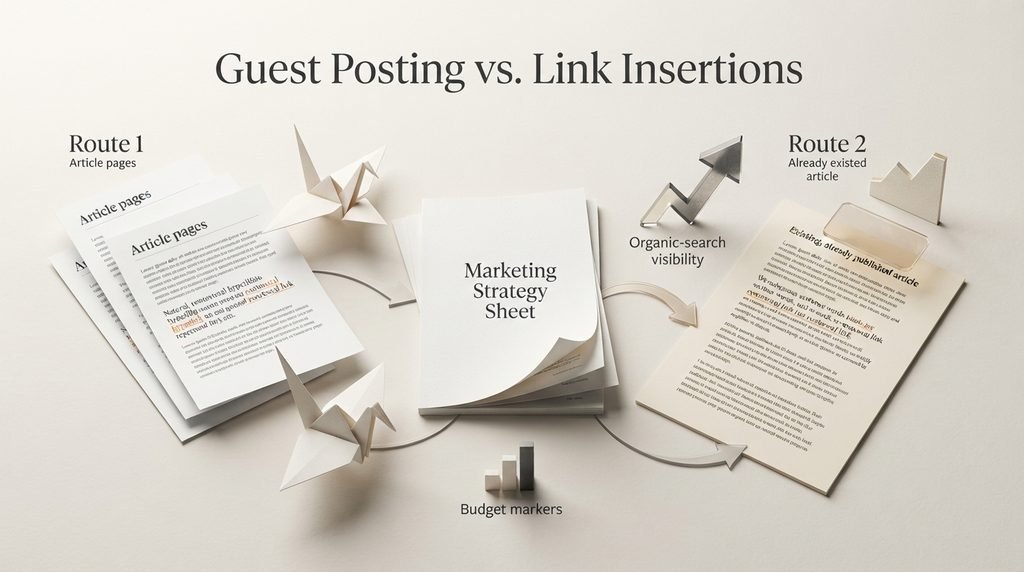
When weighing guest posting vs link insertions, most B2B SaaS founders face a tough decision. A Series A SaaS company with a $3,000-a-month link building budget has to make a call every quarter: spend it on new guest posts, or put it toward link insertions in content that’s already live. The founder isn’t trying to build a content empire; they want links that move the needle on a handful of commercial pages without burning through the marketing budget in the process. This decision shows up constantly with US and UK B2B SaaS teams, and it’s rarely as simple as “guest posts are better” or “insertions are cheaper. has to make a call every quarter: spend it on new guest posts, or put it toward link insertions in content that’s already live. The founder isn’t trying to build a content empire. They want links that move the needle on a handful of commercial pages without burning through the marketing budget in the process.
This decision shows up constantly with US and UK B2B SaaS teams, and it’s rarely as simple as “guest posts are better” or “insertions are cheaper.” The right call depends on how much content you can realistically produce this quarter, how fast you need placements live, how relevant your existing target pages are to publishers in your niche, and how much brand exposure actually matters to your growth stage.
This article breaks down guest posting vs. link insertions the way we’d walk a client through it before setting a strategy — not as a theoretical exercise, but as a practical budget decision.
What Is SaaS Guest Posting?
Guest posting, done properly, means writing an original article for a publication that already has an engaged, relevant readership, and getting a contextual link back to your site placed naturally within that content. It’s not about paying a site owner to slot in a link — it’s about contributing something a publisher’s audience would actually want to read.
For a B2B SaaS company, that usually means pitching a topic your team has real expertise in — a workflow automation angle, a data security consideration, a hiring or scaling lesson — to a publication whose readers overlap with your buyer persona. A marketing ops blog, a startup-focused trade publication, a niche SaaS newsletter. The publisher reviews the pitch, you write to their editorial standards, and the link sits inside content built specifically around your topic.
The upside here is control. You choose the anchor text context, the surrounding narrative, and often the specific page you’re pointing to. You also get genuine brand exposure — your byline, your company name, sometimes an author bio linking to your product. Done consistently, it builds actual relationships with editors and site owners, which tends to pay off well beyond a single placement.
The tradeoff is time and content cost. Someone has to write a genuinely useful article, and editors at reputable publications don’t accept filler. You’re also at the mercy of the outreach and review cycle — a placement might take two to six weeks from pitch to publish, depending on the site’s editorial calendar. For startups without in-house writers, this is where working with an agency doing B2B SaaS link building tends to make sense, since sourcing relevant publishers and managing the writing pipeline is a full-time job in itself.
Guest posting works best when your goal includes more than just the link — when you want your name in front of a specific audience, or you’re trying to establish topical authority in a niche you don’t currently rank well in.
What Are Contextual Link Insertions?
A link insertion works differently. Instead of writing new content, you’re identifying an article that’s already published, already ranks for relevant terms, and already covers a topic close enough to your product that a link to your page fits without feeling forced.
Say a publisher wrote a piece on choosing project management software eighteen months ago, and your SaaS product is a legitimate fit for a mention in that context. The publisher agrees to add a link, your team supplies a sentence or two of copy, and it goes live — often within days rather than weeks.
The obvious advantage is speed. There’s no article to write from scratch, no editorial pitch to develop, no waiting on a publishing calendar. If you’ve found a page that’s a strong topical match for one of your commercial pages, insertions can be a faster route to relevant contextual backlinks.
But speed comes with less control. You didn’t write the surrounding article, so you don’t control its overall quality, its other outbound links, or how it’s aged since publication. If the page has been neglected, covers a topic only loosely related to your product, or sits next to low-quality outbound links, the insertion isn’t doing you any favors regardless of how quickly it went live.
It’s worth being direct about something a lot of vendors gloss over: a link insertion doesn’t automatically pass authority, and it doesn’t guarantee any movement in rankings. What it can offer, in the right context, is a genuinely relevant contextual link on a page that’s already indexed and already has some history with Google. Whether that link contributes to ranking improvements depends heavily on the quality of the host page, the relevance of the surrounding content, and how that fits into your broader off-page SEO strategy — not on the insertion format itself.
Guest Posting vs. Link Insertions — Head-to-Head
| Factor | Guest Posting | Link Insertions |
|---|---|---|
| Typical turnaround | 2–6 weeks | Days to 2 weeks |
| Content requirement | Full original article | Small copy edit or added sentence |
| Control over content | High — you write the narrative | Low — existing content |
| Existing published content | No | Yes |
| Contextual relevance | Built in from the start | Depends on page relevance |
| Brand exposure | Byline, author bio, topical authority | Minimal beyond the link |
| Best use case | Relationships, authority, strong content assets | Fast placement on a relevant existing page |
| Main limitation | Time and content production cost | Less control over surrounding page |
Neither format wins across the board. A startup chasing brand visibility and long-term publisher relationships is going to get more from guest posting. A team that’s found a handful of genuinely relevant existing pages and needs placements live before a product launch might lean toward insertions. Many SaaS link building programs end up using both, just in different proportions depending on the goal.
Which Approach Makes Sense for a Tech Startup?
There’s no universal answer here, but there are clear signals that point one way or the other.
Guest posting tends to make more sense when:
- You’re trying to build relationships with publishers in a niche you don’t have existing coverage in
- Brand exposure and topical authority matter as much as the link itself
- You have a genuinely strong content angle — a specific expertise, data point, or perspective — worth pitching
- You’re earlier in your SEO program and need more editorial mentions to diversify your backlink profile
Contextual link insertions tend to make more sense when:
- You’ve already identified an existing article that’s a strong, honest topical match for your target page
- The surrounding editorial content is well-maintained and relevant, not stale or thin
- You need a placement faster than a guest post pitch-to-publish cycle allows
- You’re supplementing an existing content-heavy campaign rather than starting from zero
For most early-stage SaaS companies, the practical answer is a mix. Guest posting builds the relationships and topical depth that pay off over a longer timeline, while insertions fill in relevant gaps faster when the right existing page is available. Startups working with limited runway often start with a smaller batch of guest posts to establish a foundation, then use link building for early-stage SaaS startups approaches that blend both formats as the budget allows.
What Should SaaS Companies Check Before Choosing a Placement?
Regardless of which format you go with, the due diligence questions are largely the same:
Topical relevance. Does the publication or page actually cover subjects your buyers care about, or is the connection a stretch?
Audience fit. Who reads this site? If it’s not remotely close to your ICP, the placement’s commercial value is limited even if the metrics look fine.
Editorial quality. Read a few articles on the site before agreeing to anything. Thin, poorly edited content is a signal, regardless of what any metric says.
Page-level relevance (for insertions specifically). The individual page matters more than the domain. A strong domain with a weak, off-topic page isn’t a good insertion target.
Placement context. Where in the article does the link sit? Buried in a footer list of “additional resources” is a different proposition than a link woven into a relevant paragraph.
Publisher transparency. Will they tell you honestly what the page’s traffic and history look like, or are they vague about basics?
Realistic expectations. Any placement — insertion or guest post — is one input into a broader SEO picture. Be wary of anyone promising a link alone will move rankings.
Domain metrics like DR or DA are a starting filter, not a decision-making tool on their own. Two sites with similar DR numbers can have very different real audiences and editorial standards, which is exactly why relevance and context matter more than the score.
How Royal Growth Agency Approaches SaaS Link Building
We run manual outreach to publications with genuine relevance to SaaS and technology — not mass email blasts to whatever site will respond fastest. Every placement, whether it’s a guest post or a contextual insertion, goes through human editorial review before it’s proposed to a client, because the point is a link that fits, not a link that exists.
For clients weighing guest posts against insertions, we walk through the same tradeoffs covered above, based on their current site, their target pages, and their timeline — not a one-size-fits-all answer. Where insertions are the right call, we’re upfront about the existing page’s relevance and quality before recommending it. Where guest posting makes more sense, we handle the pitch and the writing so the client’s team isn’t stuck producing articles on top of everything else.
Clients and SEO agencies working with us can review our publisher network and placement options directly, and for agencies considering white-label support, our piece on how to evaluate a link building reseller covers the questions worth asking before you put your name on someone else’s outreach work. For a broader look at how we structure ongoing programs, our SaaS link building services page outlines what a typical engagement looks like.
The guest posting vs. link insertions decision isn’t about picking a winner — it’s about matching the format to what your site actually needs right now, and being honest about what each one can and can’t deliver.
If you’re a US or UK-based SaaS Company or an SEO agency weighing your options for off-page SEO, we’re happy to look at your current backlink profile and talk through what would make sense for your situation. Reach out through royalgrowthagency.digital or email unaiza@royalgrowthagency.digital.